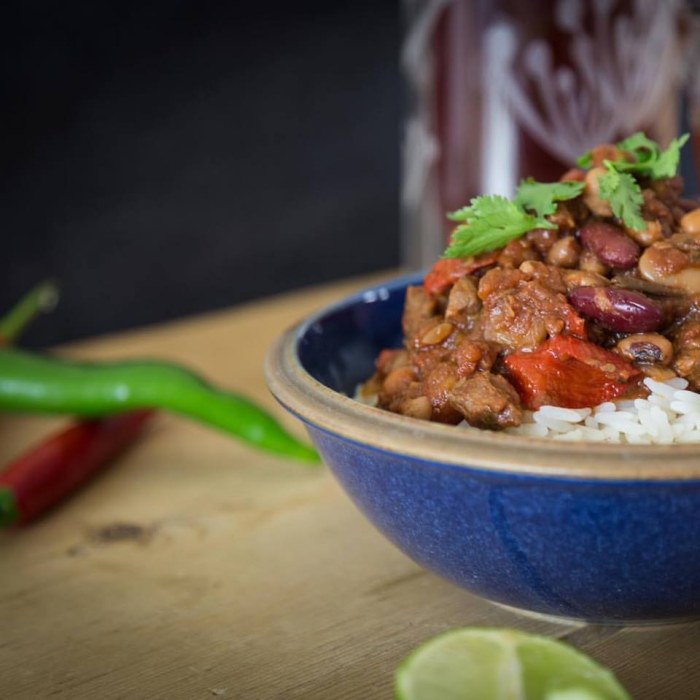
Preheat the oven to 120C/225F/gas mark 1. Take the meat out of the fridge to de-chill. Pulse the onions and garlic in a food processor until finely chopped. Heat 2 tbsp olive oil in a large casserole and sear the meat on all sides until golden. Set to one side and add another small slug of oil to brown the chorizo. Remove and add the onion and garlic, spices, herbs and chillies then cook until soft in the chorizo oil. Season with salt and pepper and add the vinegar, tomatoes, ketchup and sugar. Put all the meat back into the pot with 400ml water (or red wine if you prefer), bring up to a simmer and cook, covered, in the low oven. After 2 hours, check the meat and add the beans. Cook for a further hour and just before serving, pull the meat apart with a pair of forks.

Brown the Beef: In a large pot, brown the beef cubes. Remove and set aside. Sauté Vegetables: In the same pot, cook the onion until translucent. Add carrots, potatoes, and pumpkin, cooking for a few minutes. Simmer: Return the beef to the pot. Add broth and dried apricots. Season with salt and pepper. Simmer for 1-2 hours, until the beef is tender. Serve: Enjoy hot, with a crusty piece of bread. Pro Tips: Brown the beef in batches to ensure it gets a good sear, which adds depth to the stew's flavor. Adding the fruits towards the end of cooking preserves their texture and adds a subtle sweetness to the dish.

step 1 Soak the bread roll in the milk so it softens completely. Meanwhile, fry the onion in the oil for around 8 mins or until soft and golden. Add the fried onion to the beef mince along with the egg, garlic, marjoram and some seasoning. Squeeze the excess milk from the bread roll and add it to the mince mixture. Mix everything together and season well. step 2 Divide the meat into 8 patties. Tip the dried breadcrumbs into a shallow bowl and coat the patties in it, all over. Heat some oil in a deep frying pan and fry the patties in batches on both sides until browned and cooked through, about 6-7 mins on each side.

1 Sieve flour and add baking powder,salt,sugar,oil nd mix together 2 Add water nd knead the dough for like 10mins 3 Cover the mixture and allow it to rise 4 After it rised transfer it to a work surface and form a round (you can use a plate or pot's lid) 5 Heat ur pan and put it 6 It'll start puffing then you turn it 7 And lastly put it in in a warm place, then you'll see it has pocket
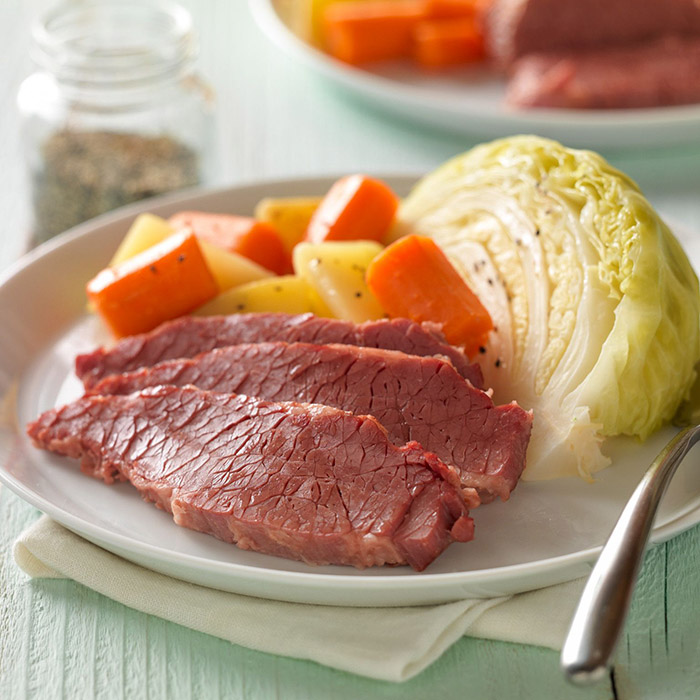
1 Place corned beef in large pot or Dutch oven and cover with water. Add the spice packet that came with the corned beef. Cover pot and bring to a boil, then reduce to a simmer. Simmer approximately 50 minutes per pound or until tender. 2 Add whole potatoes and peeled and cut carrots, and cook until the vegetables are almost tender. Add cabbage and cook for 15 more minutes. Remove meat and let rest 15 minutes. 3 Place vegetables in a bowl and cover. Add as much broth (cooking liquid reserved in the Dutch oven or large pot) as you want. Slice meat across the grain.
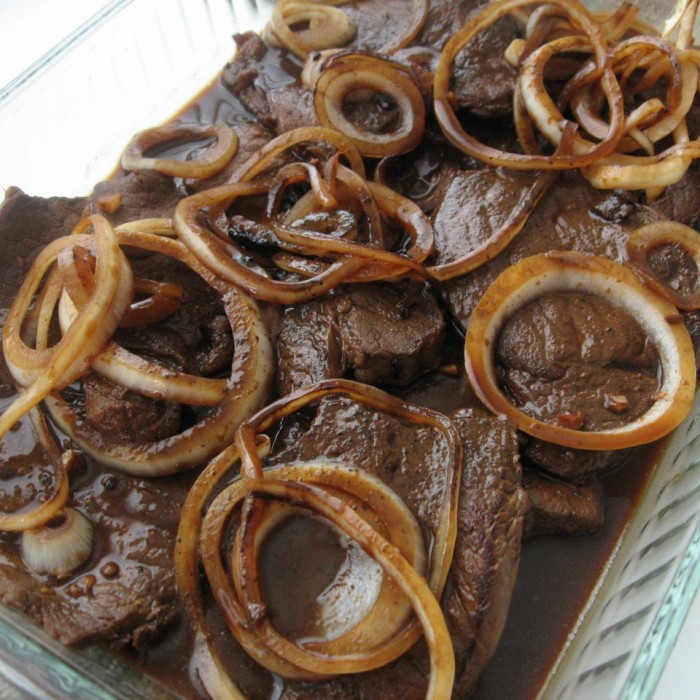
0. Marinate beef in soy sauce, lemon (or calamansi), and ground black pepper for at least 1 hour. Note: marinate overnight for best result 1. Heat the cooking oil in a pan then pan-fry half of the onions until the texture becomes soft. Set aside 2. Drain the marinade from the beef. Set it aside. Pan-fry the beef on the same pan where the onions were fried for 1 minute per side. Remove from the pan. Set aside 3. Add more oil if needed. Saute garlic and remaining raw onions until onion softens. 4. Pour the remaining marinade and water. Bring to a boil. 5. Add beef. Cover the pan and simmer until the meat is tender. Note: Add water as needed. 6. Season with ground black pepper and salt as needed. Top with pan-fried onions. 7. Transfer to a serving plate. Serve hot. Share and Enjoy!
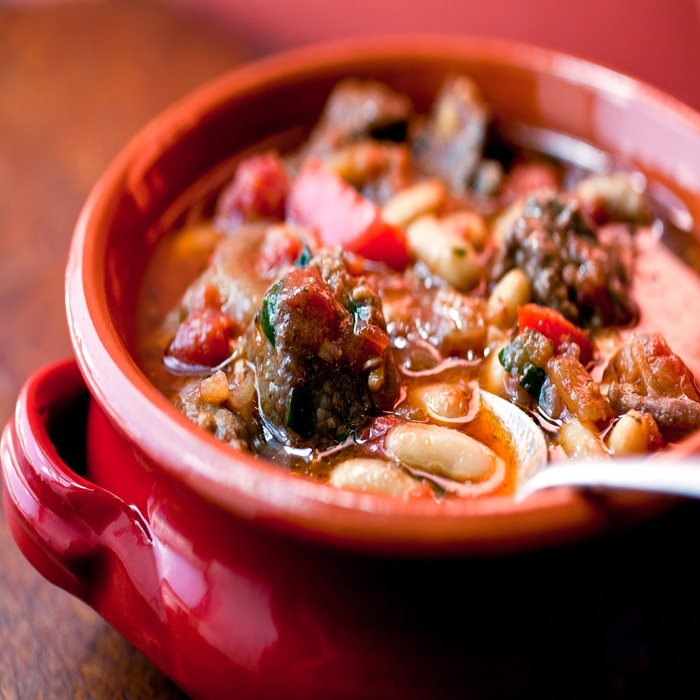
step 1 To make the spice mix, combine all of the ingredients together with a large pinch of salt. Slash the lamb shoulder all over with a sharp knife and rub in. If you have the time, marinate for up to 24 hrs, but this is not essential. step 2 Heat the oven to 150C/130C fan/gas 2. Heat the oil in a large flameproof casserole dish or roasting tin over a medium-high heat, add the onions, carrots and garlic and sizzle for 5 mins until the onions and carrots are softened. Pour over the stock, then bring to the boil. Nestle the lamb in the pan and cover, then transfer to the oven and roast for 2 hrs. step 3 Uncover and transfer the lamb to a plate using tongs. Stir the beans, peppers and olives through the stock in the pan, sit the lamb back on top and return to the oven, uncovered, for 1 hr 30 mins until the lamb is cooked through. Transfer the lamb to a board and shred using two forks. Stir the parsley through the braised beans before serving.
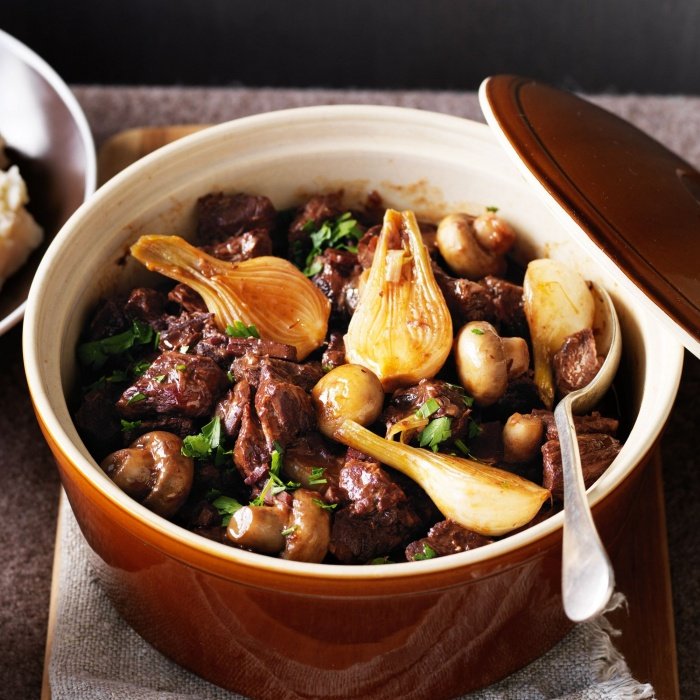
Heat a large casserole pan and add 1 tbsp goose fat. Season the beef and fry until golden brown, about 3-5 mins, then turn over and fry the other side until the meat is browned all over, adding more fat if necessary. Do this in 2-3 batches, transferring the meat to a colander set over a bowl when browned. In the same pan, fry the bacon, shallots or pearl onions, mushrooms, garlic and bouquet garni until lightly browned. Mix in the tomato purée and cook for a few mins, stirring into the mixture. This enriches the bourguignon and makes a great base for the stew. Then return the beef and any drained juices to the pan and stir through. Pour over the wine and about 100ml water so the meat bobs up from the liquid, but isn’t completely covered. Bring to the boil and use a spoon to scrape the caramelised cooking juices from the bottom of the pan – this will give the stew more flavour. Heat oven to 150C/fan 130C/gas 2. Make a cartouche: tear off a square of foil slightly larger than the casserole, arrange it in the pan so it covers the top of the stew and trim away any excess foil. Then cook for 3 hrs. If the sauce looks watery, remove the beef and veg with a slotted spoon, and set aside. Cook the sauce over a high heat for a few mins until the sauce has thickened a little, then return the beef and vegetables to the pan. To make the celeriac mash, peel the celeriac and cut into cubes. Heat the olive oil in a large frying pan. Tip in the celeriac and fry for 5 mins until it turns golden. Season well with salt and pepper. Stir in the rosemary, thyme, bay and cardamom pods, then pour over 200ml water, enough to nearly cover the celeriac. Turn the heat to low, partially cover the pan and leave to simmer for 25-30 mins. After 25-30 mins, the celeriac should be soft and most of the water will have evaporated. Drain away any remaining water, then remove the herb sprigs, bay and cardamom pods. Lightly crush with a potato masher, then finish with a glug of olive oil and season t
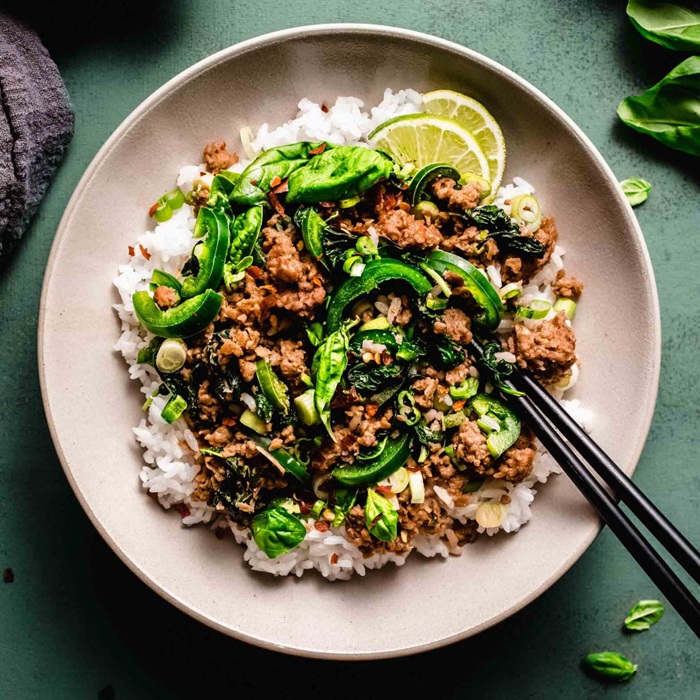
step 1 Heat a wok or large frying pan until smoking hot. Pour in the oil and swirl around the pan, then tip in the beef strips and chilli. Cook, stirring all the time, until the meat is lightly browned, about 3 mins, then pour over the oyster sauce. Cook until heated through and the sauce coats the meat. stir in the basil leaves and serve with plain rice.
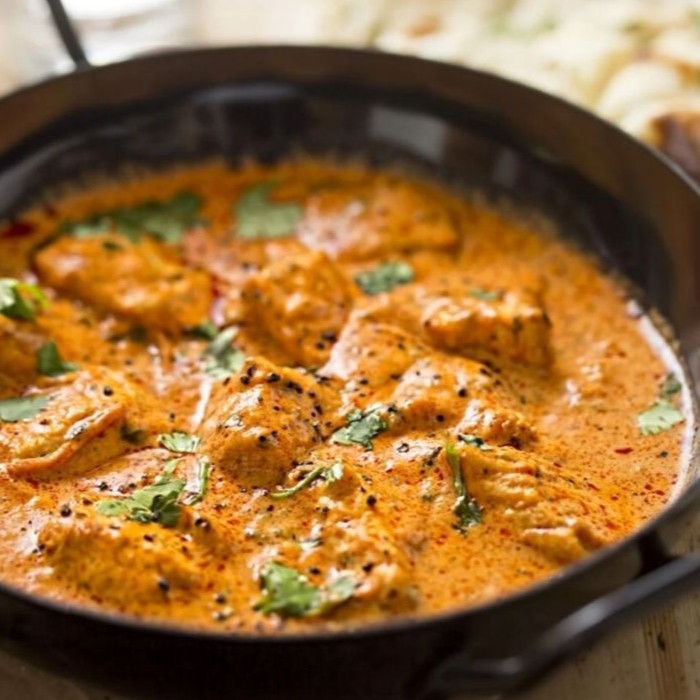
Bring the 4 cups of water to a boil in a Dutch oven or soup pot. Add the beef, garlic, and ginger, and stir well. Bring to a gentle simmer, cover, and cook, stirring occasionally, for 20 minutes. If you get any foamy scum on the top, not to worry, simply spoon it away or stir it back in. Remove from the heat, and drain, but reserve the excess water for later. Return the pot or Dutch oven to medium heat with the 2 tablespoons of cooking oil. Once the oil is shimmering, add the onions and cook, stirring occasionally, until softened, 5 to 7 minutes. Add the tomatoes to the onions, and continue cooking, stirring occasionally, until the tomatoes are falling apart, 3 to 5 minutes. Add the drained beef to the tomato and onion mixture, and stir well. Continue cooking over medium heat for 5 minutes, stirring occasionally. Add the paprika, pepper, curry powder, tomato paste, and salt to taste, and stir well. Add back the excess water that was used for cooking the beef, along with enough extra water to cover. Bring to a boil, reduce heat, and simmer, uncovered, stirring occasionally, for about 1 hour, or until the meat is tender and the sauce is thickened. Add additional water if your beef curry begins to dry and stick, or if would like your curry to have more of a soupy consistency. When the beef curry is ready, remove from the heat, give it a taste, and adjust the seasonings as desired. Garnish with fresh chilis and cilantro.

step 1 Put the cabbage in a heavy casserole dish, add the stock and cook over a low heat for about 50 mins, until tender. step 2 Cut the soaked mushrooms into strips and save the soaking water. Heat the lard and fry the sausages and bacon, then scoop out, leaving the fat in the pan. Fry the onion in the same pan for 5-8 mins until lightly browned. step 3 Add the mushrooms and their liquid along with all the cooked meat, onions and prunes, then cover and cook for 20 mins. Add the spices, red wine and tomato purée and bring to a simmer, then cover and cook for 1 hr. Season well and leave to cool. Will keep covered and chilled for up to two days. Bigos improves in flavour over a couple of days. Leave to cool first. Reheat until piping hot before serving.

step 1 Tip the beef stock along with 500ml of water into a large saucepan. Sit the onion and ginger in a frying pan over a high heat and char on all sides, around 3-5 mins (you can also do this under your grill). Once charred, add to the beef stock. In the same pan, toast the spices for 2-3 mins and once they begin to smell fragrant, add them to the beef stock as well. Bring the stock to the boil, then turn to a simmer and cook for 30mins before straining. step 2 Meanwhile, cut the fat from the steak and wrap in cling film, then put into the freezer for 15 mins – this will make your steak really easy to slice! Slice it thinly, then cover with cling film again and pop into the fridge. step 3 Taste the beef stock and use the palm sugar, fish sauce and soy to season. Cook the noodles according to package instructions and split between two bowls, topping each with the sliced beef. Bring the stock to the boil and then pour into the bowls (the heat will cook the beef). Top each with the spring onions, chilli slices and herbs. Serve with the lime wedges to squeeze over.
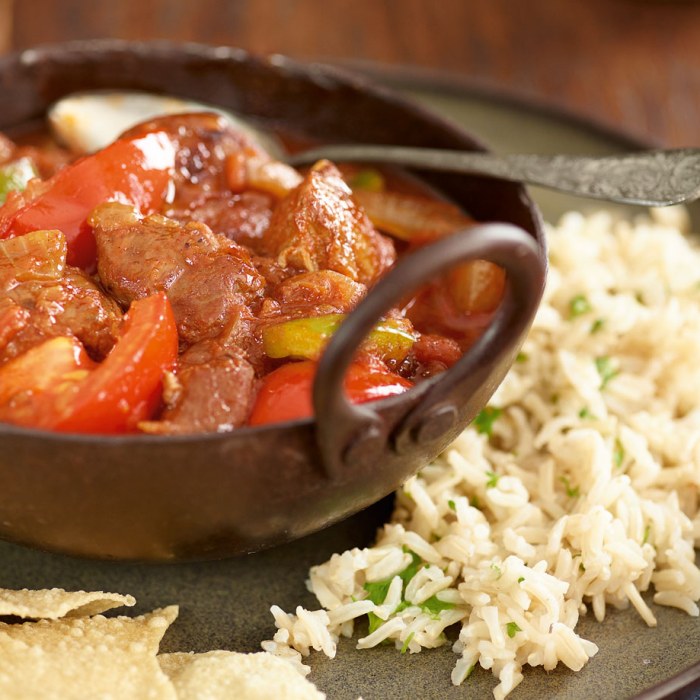
Put the onions in a food processor and whizz until very finely chopped. Heat the oil in a large heavy-based pan, then fry the onion with the lid on, stirring every now and then, until it is really golden and soft. Add the garlic and ginger, then fry for 5 mins more. Tip the curry paste, all the spices and the bay leaves into the pan, with the tomato purée. Stir well over the heat for about 30 secs, then add the meat and 300ml water. Stir to mix, turn down the heat, then add the yogurt. Cover the pan, then gently simmer for 40-60 mins until the meat is tender and the sauce nice and thick. Serve scattered with coriander, with plain basmati or pilau rice.
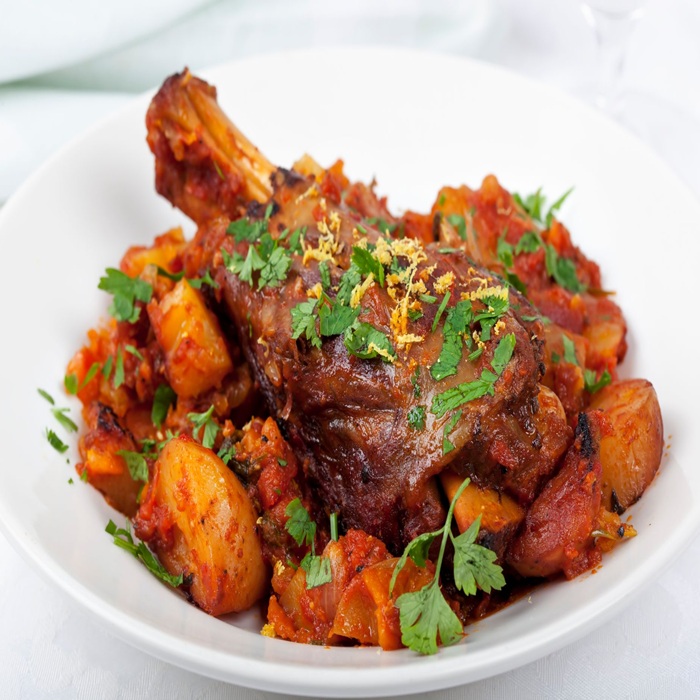
step 1 Heat oven to 160C/140C fan/gas 3. Heat 1 tbsp oil in a heavy-bottomed casserole, season the shanks, then brown them 2 at a time on all sides, adding the remaining oil for the second batch. Remove the lamb and add the onions. Fry them quite briskly, about 30 secs, add the ginger, garlic and chopped chilli, then turn the heat down and cook for 1 min. Add 1 tbsp sugar, stir, then add the star anise, lemongrass, stock, purée and seasoning. Bring to the boil. step 2 Cover and cook in the oven for 1½ hrs, then add the sweet potatoes and cook for 1 hr more. The lamb should be completely tender and almost falling off the bones. Stir in the fish sauce, lime juice and 1 tsp sugar to just lift the flavour, then scatter with the mint, basil and the sliced chilli to serve.
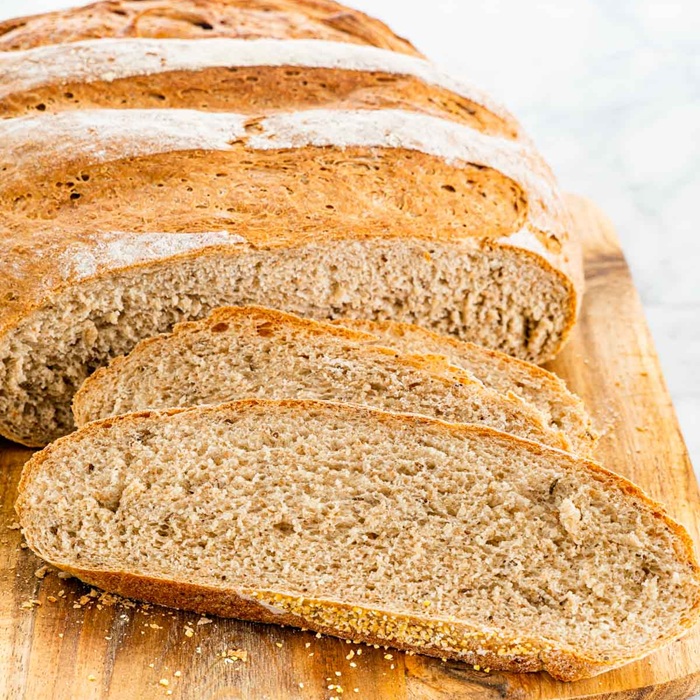
step 1 Tip the flours, yeast and salt into a bowl. In a jug, mix the honey with 250ml warm water, pour the liquid into the bowl and mix to form a dough. Rye flour can be quite dry and absorbs lots of water, if the dough looks too dry add more warm water until you have a soft dough Tip out onto your work surface and knead for 10 mins until smooth. Rye contains less gluten than white flour so the dough will not feel as springy as a conventional white loaf. step 2 Place the dough in a well oiled bowl, cover with cling film and leave to rise in a warm place for 1-2 hrs, or until roughly doubled in size. Dust a 2lb/900g loaf tin with flour. step 3 Tip the dough back onto your work surface and knead briefly to knock out any air bubbles. If using caraway seeds work these in to the dough. Shape into a smooth oval loaf and pop into your tin. Cover the tin with oiled cling film and leave to rise somewhere warm for a further 1 – 1.5 hr, or until doubled in size. step 4 Heat oven to 220C/200C fan/gas 7. Remove the cling film and dust the surface of the loaf with rye flour. Slash a few incisions on an angle then bake for 30 mins until dark brown and hollow sounding when tapped. Transfer to a wire cooling rack and leave to cool for at least 20 mins before serving
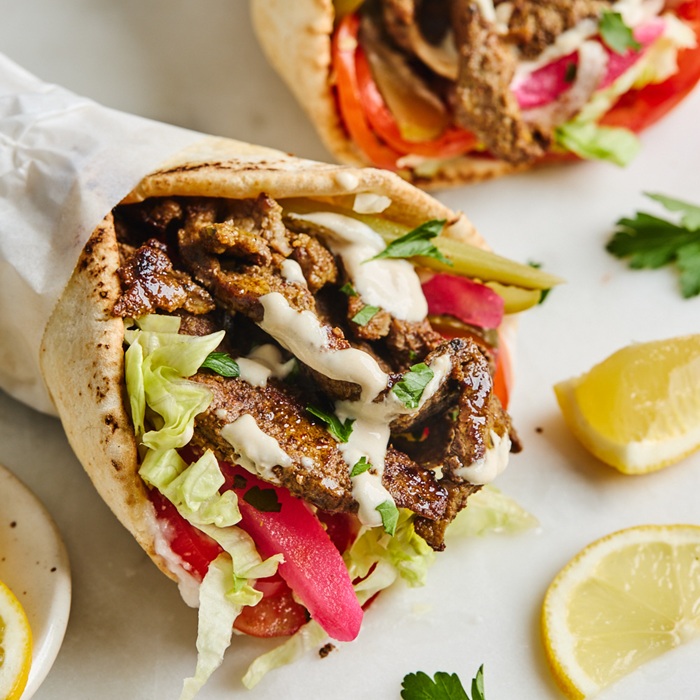
1 In a dutch oven or slow cooker, add all the spices, beef broth and lemon juice. Stir to combine.. 2 Add the beef and turn to coat, spoon some sauce over the top. 3 Cover and cook on low for 8-10 hours. 4 After cooking, remove beef and use two forks to shred. Discard any excess fat. 5 Skim fat off of the top of the liquid remaining. 6 Mix shredded beef into sauce. Keep warm until you are ready to serve. 7 Build wrap by spreading garlic sauce on the pita. Top with beef and add garnishes to your liking. 8 Fold it burrito style. 9 Heat a grill pan and grill the wrap.
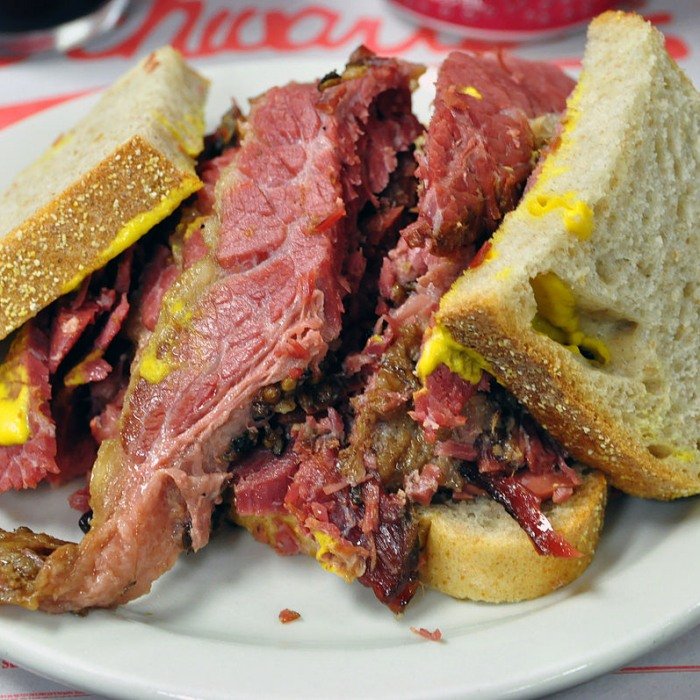
To make the cure, in a small bowl mix together salt, pink salt, black pepper, coriander, sugar, bay leaf, and cloves. Coat entire brisket with the cure and place in an extra-large resealable plastic bag. Place in the coldest part of the refrigerator and cure for 4 days, flipping brisket twice a day. Remove brisket from bag and wash as much cure off as possible under cold running water. Place brisket in a large container and fill with water and let soak for 2 hours, replacing water every 30 minutes. Remove from water and pat dry with paper towels. To make the rub, mix together black pepper, coriander, paprika, garlic powder, onion powder, dill weed, mustard, celery seed, and crushed red papper in a small bowl. Coat entire brisket with the rub. Fire up smoker or grill to 225 degrees, adding chunks of smoking wood chunks when at temperature. When wood is ignited and producing smoke, place brisket in, fat side up, and smoke until an instant read thermometer registers 165 degrees when inserted into thickest part of the brisket, about 6 hours. Transfer brisket to large roasting pan with V-rack. Place roasting pan over two burners on stovetop and fill with 1-inch of water. Bring water to a boil over high heat, reduce heat to medium, cover roasting pan with aluminum foil, and steam brisket until an instant read thermometer registers 180 degrees when inserted into thickest part of the meat, 1 to 2 hours, adding more hot water as needed. Transfer brisket to cutting board and let cool slightly. Slice and serve, preferably on rye with mustard.

Heat oven to 200C/fan 180C/gas 6. Fry the onions and thyme sprigs in the oil until softened and lightly coloured (about 5 mins). Spread a layer of potatoes over the base of a 1.5-litre oiled gratin dish. Sprinkle over a few onions (see picture, above) and continue layering, finishing with a layer of potatoes. Pour over the stock and bake for 50-60 mins until the potatoes are cooked and the top is golden and crisp.
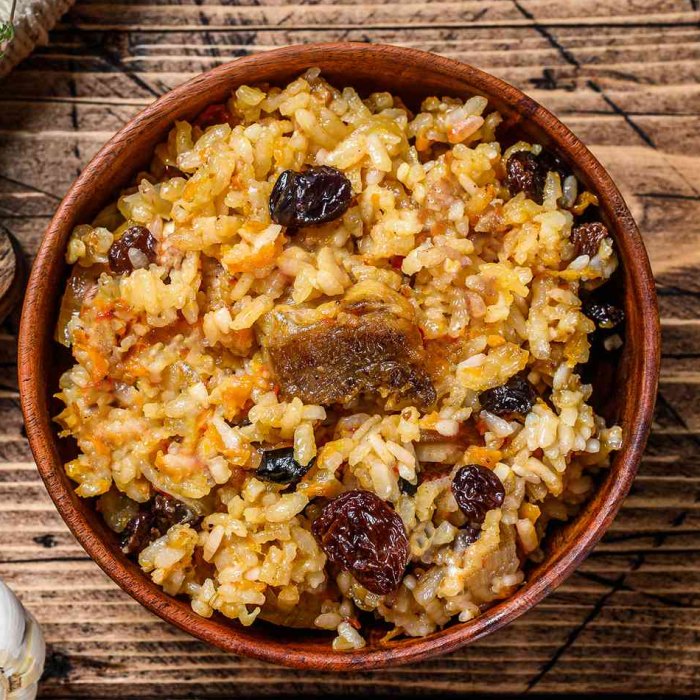
Place the raisins and prunes into a small bowl and pour over enough water to cover. Add lemon juice and let soak for at least 1 hour. Drain. Roughly chop the prunes. Meanwhile, heat the butter in a large pan, add the onion, and cook for 5 minutes. Add cubed lamb, ground lamb, and crushed garlic cloves. Fry for 5 minutes, stirring constantly until browned. Pour 2/3 cup (150 milliliters) of stock into the pan. Bring to a boil, then lower the heat, cover, and simmer for 1 hour, or until the lamb is tender. Add the remaining stock and bring to a boil. Add rinsed long-grain white rice and a large pinch of saffron. Stir, then cover, and simmer for 15 minutes, or until the rice is tender. Add the drained raisins, drained chopped prunes, and salt and pepper to taste. Heat through for a few minutes, then turn out onto a warmed serving dish and garnish with sprigs of flat-leaf parsley.

Place a steamer insert into a saucepan, and fill with 1 1/2 cups of water, or just below the bottom of the steamer. Cover, and bring the water to a boil over high heat. Add the sliced carrots, reduce the heat to medium, and cover the pan again. Steam until tender but not mushy, 4 to 6 minutes depending on the thickness of the slices. Reserve 1/2 cup of the cooking liquid. Heat the olive oil in a skillet over medium heat. Reduce the heat to low and stir in the salt, pepper, cinnamon, cumin, garlic, and thyme. Cook the spices and garlic, stirring frequently, until fragrant, about 10 minutes. Add the 1/2 cup reserved cooking liquid and the bay leaf, cover, and simmer for 20 minutes. Stir in the carrots, tossing well to coat with the spice mixture, and cook until heated through, about 2 to 3 minutes. Sprinkle with lemon juice and remove the bay leaf before serving.

Preheat oven to 410° F. Pour the water into a large bowl. Make sure it is room temperature. Add the salt. Blend well with a mixer, fork or spatula to make sure it dissolves well. While you continue to beat the mixture, slowly add the corn meal—a little bit at a time. Once all the flour is added, keep mixing until the corn meal, water and salt are thoroughly blended and dissolved. Set aside the masa in its bowl. Let it rest for 5 minutes so that the flour is thoroughly hydrated. This type of corn flour does not have any gluten, so it doesn’t need to be kneaded. The masa should be smooth, firm yet malleable. While waiting for the 5 minutes’ rest, heat your budare (or comal, griddle, cast-iron pan or non-stick pan) over medium heat. Coat with a little bit of the oil. Fill a small bowl with water to wet your hands to make the arepas. Take about 2 Tbsp of the masa in your damp hands. The masa should fit easily in your palm so that it is easy to shape into a small ball. Cross your hands, so that one is on top of the other, with the masa ball between them. Rotate your right hand in a circle, so that you are at the same time both pressing the masa into a flat disc and keeping its round shape. arepa making The last step in shaping your arepa is to quickly pass and lightly press the masa disc from one hand to the other until it is about ¾ of an inch thick and 4 inches wide. Smooth the edges with your fingertips (quickly dip them into the water bowl first) so that they stay as round as possible and without cracks. arepa making Place your arepas in batches on the preheated surface of your budare griddle or nonstick pan. Let each side turn golden, about 4 to 5 minutes per side. Check them often so that they don’t burn. Once they are nicely browned on both sides, place the arepas on a baking sheet in your preheated oven for 10 minutes. They should be somewhat puffy, so that if you tap an arepa lightly on top, it will sound like you are tapping an empty box. Serve

step 1 Put a sieve over a large bowl, line it with a thick sheet of non-dyed kitchen paper or a clean muslin cloth, and spoon in the yogurt. Cover with another sheet of kitchen paper and leave to strain in the fridge for a minimum of 12 hrs. step 2 Add the lemon juice, most of the olive oil and the dried mint to a bowl and stir well for the dried mint to soften and soak up the juices. Mix in the strained yogurt, then pour away the strained yogurt liquid and leave that bowl to one side. step 3 Halve the cucumber(s) lengthways and remove the seeds by running a teaspoon from the top to the bottom of the flesh, halve the cucumbers widthways to make them shorter and easier to handle, then coarsely grate each one into the bowl the yogurt was straining over. Using clean hands (or a clean muslin cloth), squeeze as much of the liquid out of the cucumber as possible. step 4 Add the strained, grated cucumber, garlic and ¾ tsp flaky salt to the rest of the ingredients and mix well. Garnish with a drizzle of extra virgin olive oil and a sprinkling of dried mint.
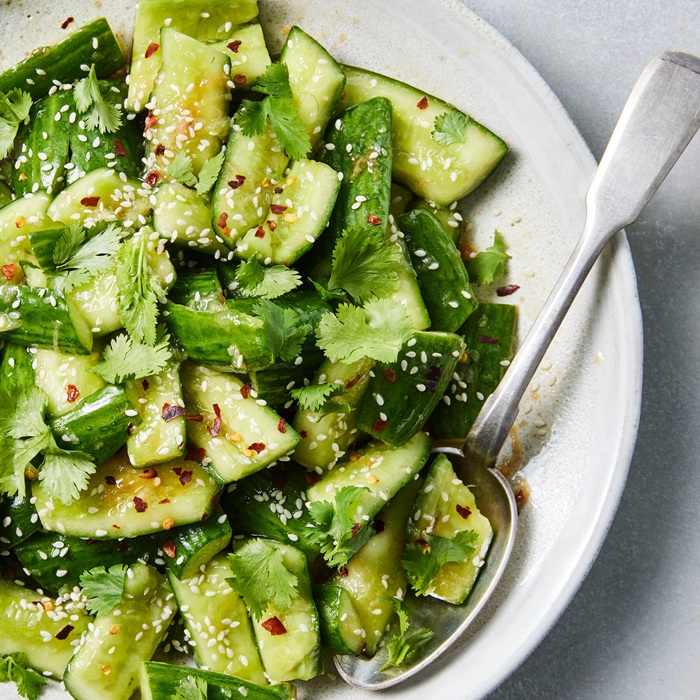
Prep the cucumbers: Peel the cucumbers. Cut them into quarters, lengthwise. (If the seeds are bitter, scrape out the seeds and discard.) Cut the cucumbers again, crosswise, into 1/2-inch thick pieces. Toss the salad: Place cucumbers into a serving bowl. Sprinkle with salt. Toss with sesame oil, seasoned rice vinegar, basil (if using), and chili flakes. Sprinkle with toasted sesame seeds if using.
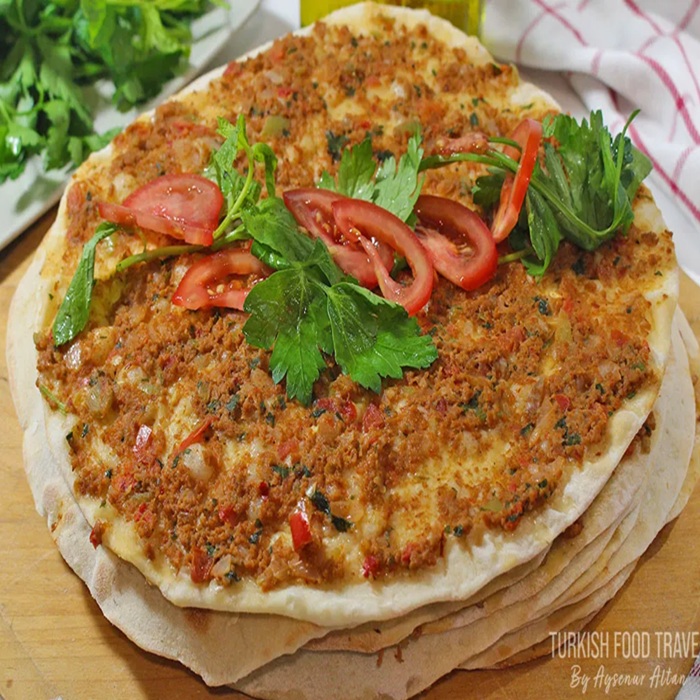
step 1 Sift the flour into a large bowl, make a well in the middle and sprinkle in the yeast. Pour 125ml water over the yeast, then flick flour over the liquid to create a layer. Cover and leave to rise in a warm place for 15 mins until cracks appear on the surface of that layer. step 2 Use your hands to mix in 250ml more water along with 1 tsp salt and knead the dough for about 10 mins until elastic and no longer sticky. Add a little more flour if you need to. Cover and leave to rise again in a warm place for 30 mins until doubled in size. step 3 Heat the oven to as high as it will go (about 240C/220C fan/gas 9) and sprinkle one or two baking trays thinly with cornmeal. step 4 Pour boiling water from the kettle over the tomatoes, leave to stand briefly, then drain and slip off the skins. Cut the tomatoes in half, cut out the stalks, scoop out the seeds and discard, then chop the flesh. step 5 Halve the chillies lengthways, cut out the stalks, seeds and white inner membrane, then rinse. Cut lengthwise into fine strips, then crosswise into fine dice. step 6 Put the tomatoes, chillies, spring onions, finely chopped parsley, beef mince, spices, 1 tsp salt and ½ tsp freshly ground black pepper into a bowl and mix well. step 7 Take the dough and knead it briefly, then divide into four pieces and shape each into a ball. Roll each ball into a thin circle, place on the prepared baking trays. Spread with a thin layer of the meat mixture. step 8 Bake each flatbread for 10-15 mins until the edges begin to darken. After removing from the oven, sprinkle the lahmacun with the roughly chopped parsley and sliced onion, then squeeze over a few drops of lemon juice. Serve straightaway.